


Jev wasn't an accident.
It wasn't as if the conscious mind of the masses fused together one afternoon and pinpointed this amazing new tech. We're not that smart.
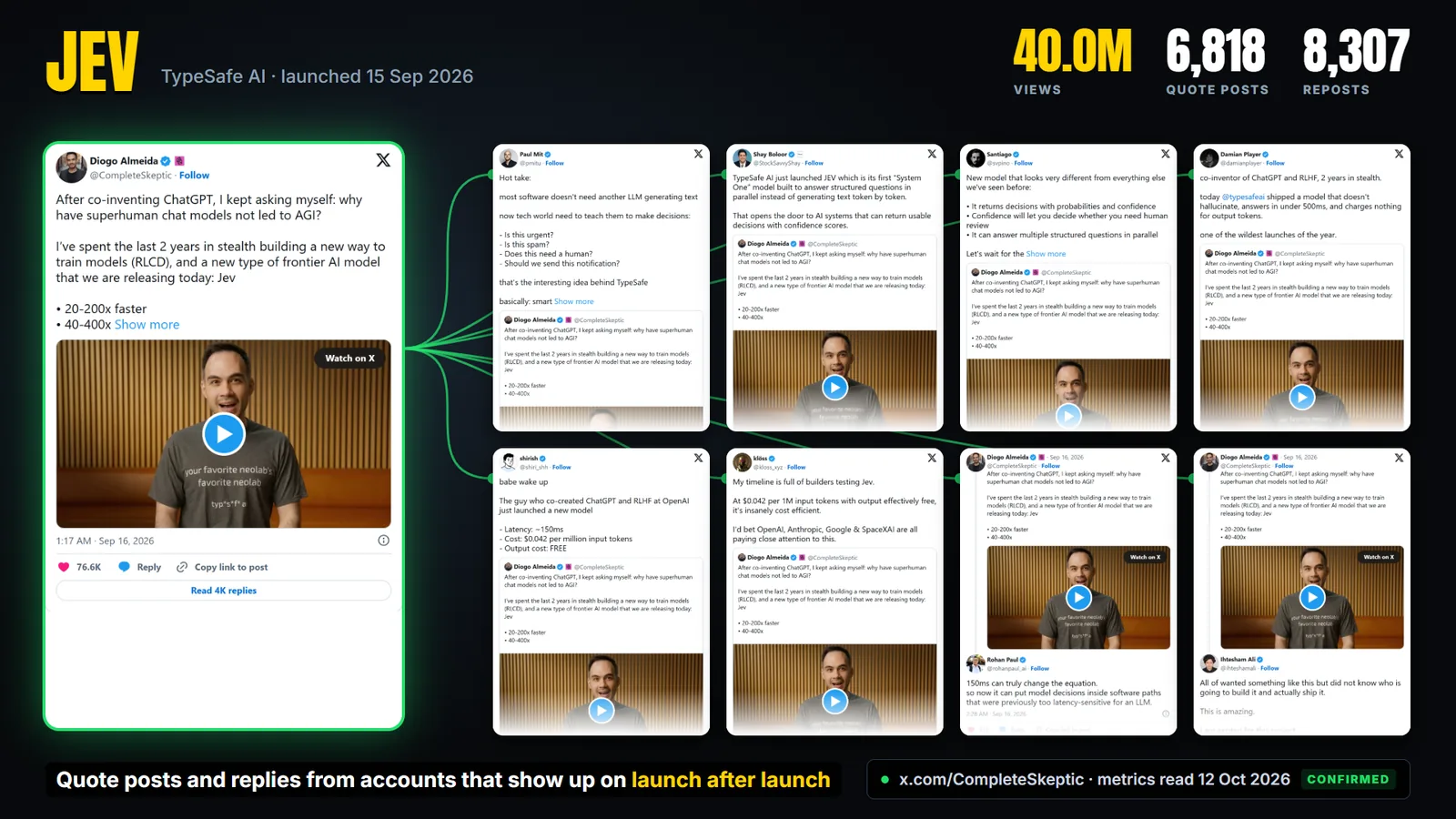
If you missed it: in September a company called TypeSafe launched a model called Jev. Forty million views. 6,818 quote posts. Your whole timeline losing its mind for a day. About three weeks later the company raised at a seven and a half billion dollar valuation.
That's not because the guy was ex-OpenAI. That's marketing.
So there's a guy named Damian. He's the CEO of the biggest company doing this. And he writes, on his own blog, that he limits how many launches he runs to what the network will carry:
"…without the audiences noticing a pattern."
Damian Player, damianplayer.com
I guess I noticed. But I've always had a feeling this was going on.
I've been getting busy with YouTube when I'm not helping my wife with our newborn, and it's becoming really fun. I spent a lot of time on this one looking into who's paying to appear on your timeline. The companies, their clients, the creators, and where the views actually come from. By the end I'll show you the hidden trail they leave behind.
Credit first
A guy named Ben, whose channel is Science Based AI, put out a video called "Exposing why every AI launch goes viral on X." Go watch it. It's a great video and he covers a lot of this.
My first thought was an obvious… yeah, no shit? My second was: okay, let's go deeper and figure out who and what.
I'm an AI dev, so I pointed a bunch of my "investigator agents" at his video and my notes on it and told them to follow the breadcrumbs. Domain registrations. Archived versions of sites. Page source. Posts, likes, how fast the replies came in and from whom.
And before I got into development I was the CRO and CSO of a few successful companies, so I'm not exactly shocked by marketing strategies. I once had a competitor create "independent" review sites that compared their product to mine, purely for the SEO value. Shit's crazy.
The thing that really pisses me off is when you can't tell what's an ad and what's real.
Why one fake like matters
There's an actual study on this, published in Science in 2013. Researchers ran an experiment on a Reddit-style news site where they gave random comments one fake upvote. Just one.
The next person who saw that comment was 32% more likely to upvote it too. And by the end, those comments were rated 25% higher on average.
One fake like, and the crowd does the rest.
That's the whole business model, really. You don't have to fake the crowd. You have to fake the first hour.
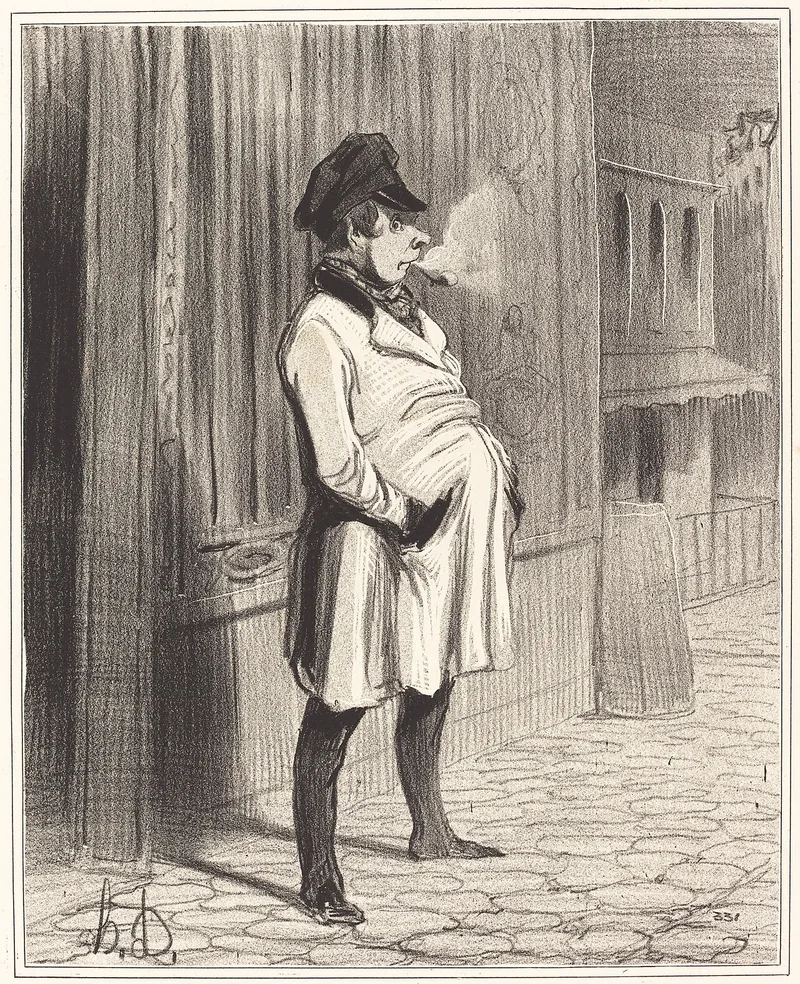

None of this is new, btw. Paris theatres in the 1800s had the claque: people you paid to sit in the audience and clap. It was organised. There was a boss, and there were specialists. Some were paid to laugh at the jokes, some to cry at the sad parts, some to shout for an encore. By 1820 there was an agency in Paris selling it as a service. Daumier drew the guy.
So when somebody tells you engineered applause is a clever new growth hack, it's about two hundred years old. What's new is that the audience is an algorithm.
Doomers. Literally Doomers.
The big one is called Doomers. Doomers dot AI. What the fuck?
Their claim is that they engineer the X algorithm. They seed something like 80 to 100 accounts to help launch your stuff. If you're a founder, that's a really attractive offer.
Here's how it works, going by their own playbook. A bunch of creators each get a custom brief. They post sensational headlines about your launch. It's supposed to look organic, not copy-pasted. Then the founder has to show up and reply to everyone, about thirty minutes after they post.
Engagement for sale!
Damian explains why it works better than I could. If forty accounts you follow all post about the same thing in one afternoon, you, in his words, "read it as consensus." And that, he says, is "what companies are buying."
Honestly? I might use him myself in the future. Who knows.
But let me repeat myself. They're not buying ADS. They're BUYING CONSENSUS. They're buying the feeling that everyone you respect already agrees.
So who are these people?
The doomers.ai domain was registered on March 23rd of this year. Six months old when I looked. Their press release says a ten-million-dollar run rate. It's their only press release and it's a paid one.
Back in February, Damian's website was still selling AI ops consulting. Six weeks later he's engineering the X algo. I respect the hustle. If I could do it, I'd probably do it too. Or at least use the skills to get more popular on YouTube.
The co-founder is described as a former VC with 150K followers. No handle. No fund. He's a ghost.
They're not alone
| Shop | The pitch | The detail |
|---|---|---|
| Doomers | "Engineer the X algorithm." 80–100 seeded accounts per launch. | Domain registered March 2026. Runs a public leaderboard of everybody's launches, including its own. |
| Clickstrike | "Turn your next announcement into a viral moment on X." $35 per 1,000 views. | Owned by a New York group called Nowbound, which also owns Coinbound, a crypto influencer agency since 2018. |
| launchvideo.com | Homepage guarantees 3 or 5 million views. | The terms of service say otherwise. Parent company also runs a clipping network. |
| Nowix | A wave of 600 micro-influencers. | One-person shop. Their blog says the wave "creates the appearance of a grassroots movement." |
The Clickstrike one made something click for me. I was in Singapore for SuperAI recently and I kept seeing the same pattern: a lot of crypto influencers and marketers who've now switched over to AI.
Seems legit.
The launchvideo.com guys are pretty cool. Guaranteed views on the homepage, and a terms of service that takes it back. Great.
Okay.
And Nowix has to be my favourite. "Creates the appearance of a grassroots movement." More like astroturf. Was that a dad joke? I have a newborn, I'm allowed.
Who's buying
Those guys do the selling and, to their credit, they're great at it. But look at who's buying.
The client logos are big. Perplexity. Glean. Bolt. Tavus. Higgsfield. Odyssey. And TypeSafe, which was the Jev launch.
Here's the fucked up thing. Across more than a hundred client launches that these agencies claim, not a single client publicly confirmed hiring any of them. It's like they're secret recess buddies and can't hang out during class.
The launches are real. The funding is real. The views are real too.
Sometimes the agencies don't even agree with each other, which is funny as fuck. Tavus launched a model called Griffin on October 1st. 21 million views. Doomers says that's their launch. The Launch Video Company also claimed it as theirs. Same post. Two case studies.
Where the virality actually comes from
This is the part I did myself. I took 64 launch posts from Doomers' clients and 120 random launches that aren't clients, and looked at who shows up in the first hour.
The same two dozen accounts keep showing up.
That's the share of top replies written by that same small group. Twelve and a half percent on client launches. 1.4 on the randoms. Some of those accounts are on 8 to 13 of the 20 Doomers clients, and on zero or MAYBE one of the hundred-odd random companies. Doomers' own CEO is one of them.
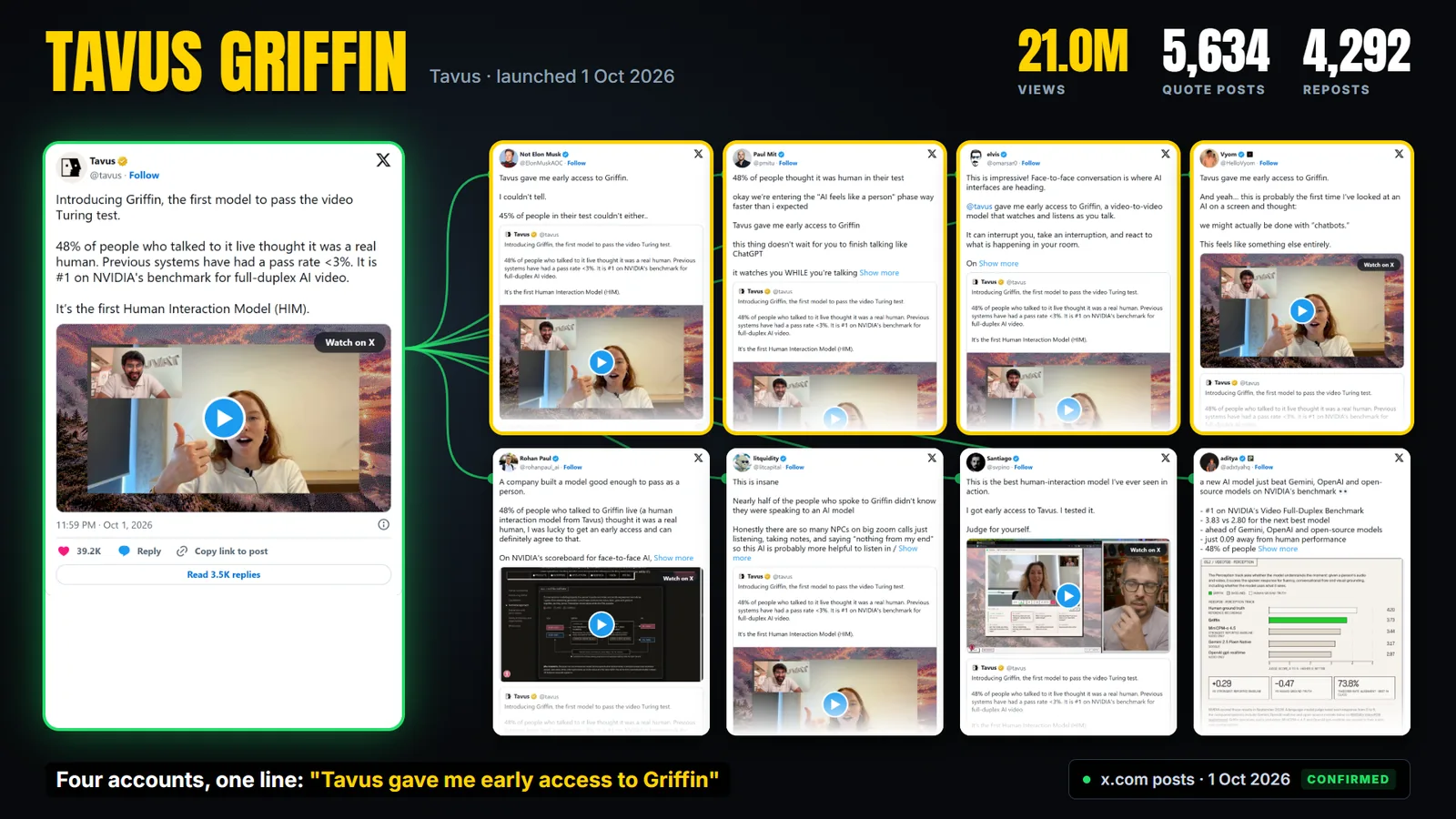
On the Tavus launch, four different accounts posted almost exactly the same sentence: "Tavus gave me early access to Griffin." That's not even a custom brief anymore. Maybe quality control gets rough with all the growth and success?
To be fair, and to be precise: accounts appearing together is not proof that anyone was paid. These are my own counts from public post data, read on October 11, 2026. What they show is that the first hour of a client launch looks very different from the first hour of anyone else's.
The labels, and what they miss
Credit where it's due, and I was surprised by this. About 84% of the quote posts I looked at were labelled "Paid partnership." 80 out of 96. So the main posts are mostly being disclosed. That's better than crypto Twitter ever did.
But here's the thing.
Zero out of fifteen first-hour replies had a label. And you can't label a repost at all.
And guess what? X's own published code says a reply counts for ten times what a like does.
like:   0.5
reply:  5
quote:  5
(Those are the weights as I read them in October. They get retuned, so check the file.)
It means the stuff that ACTUALLY pushes the algorithm is the stuff with no label on it.
The label doesn't even say who paid, btw. I found the same group mass quote-posting six launches in one month that no agency claims at all. All labelled paid partnerships. Paid by whom? Doesn't say.
What X's own code says
A while back X open-sourced its algorithm, and there's literally a comment in the code about this. It says an action only counts if it happens on a post served in your home timeline, and that:
"Directly navigating to a post (i.e., coordinating via groupchat) has no ranking impact."
Code comment, github.com/xai-org/x-algorithm
So the old trick is dead. Everybody piling into a group chat, clicking the link and hitting like does nothing. It only counts engagement on posts you saw in your feed.
Which tells you exactly what to buy instead. You pay big accounts to quote-post. Those quote posts land in their followers' feeds. Their followers engage. Now the algorithm thinks this is a thing.
So you're not buying likes. You're renting other people's audiences to trick the algo.
It's clipping, just for Twitter
This is almost literally the same game as clipping.
How many times have you seen that same Andrew Tate, or Caleb Hammer, or Neon clip on a thousand different channels? Do you think those channels are doing it because they're fans of the content?
Clipping is a multi-billion-dollar business. Creators literally advertise "clip my stuff and I'll pay you per thousand views." Then a bunch of kids chop up the videos and spray and pray, hoping their clip hits the big time.
- MrBeast has over a thousand clippers, according to Bloomberg.
- MLB pays a dollar per thousand views.
- Polymarket has them.
- Cluely, the "cheat on everything" startup? Their founder said he hired over 700.
I hate their startup but I fucking love their memes. The guy smoking in the office and that dev obsessed with trains are great.
And remember launchvideo.com? Their parent company runs a clipping network too. Ten thousand plus accounts, three bucks per thousand views. Launch wave on X, clip farm on TikTok. Same company.
On YouTube you get clips. On X you get quote posts. Either way it's simulated hype bullshit. The difference is that while they charge like ads, they don't look like ads and they mostly don't get labelled like ads.
The view count is doing two jobs
Oh right. X's own documentation says the view count you see is a combined total, organic plus promoted. One number. You can't split it. Only the post's owner can, and only for thirty days.
A normal viral launch gets about one like for every 500 or 600 views. Jev sits right around there, which is what a creator wave looks like: real people in real feeds leaving real likes. That's why it works, and why it's so hard to spot.
Now look at this one.
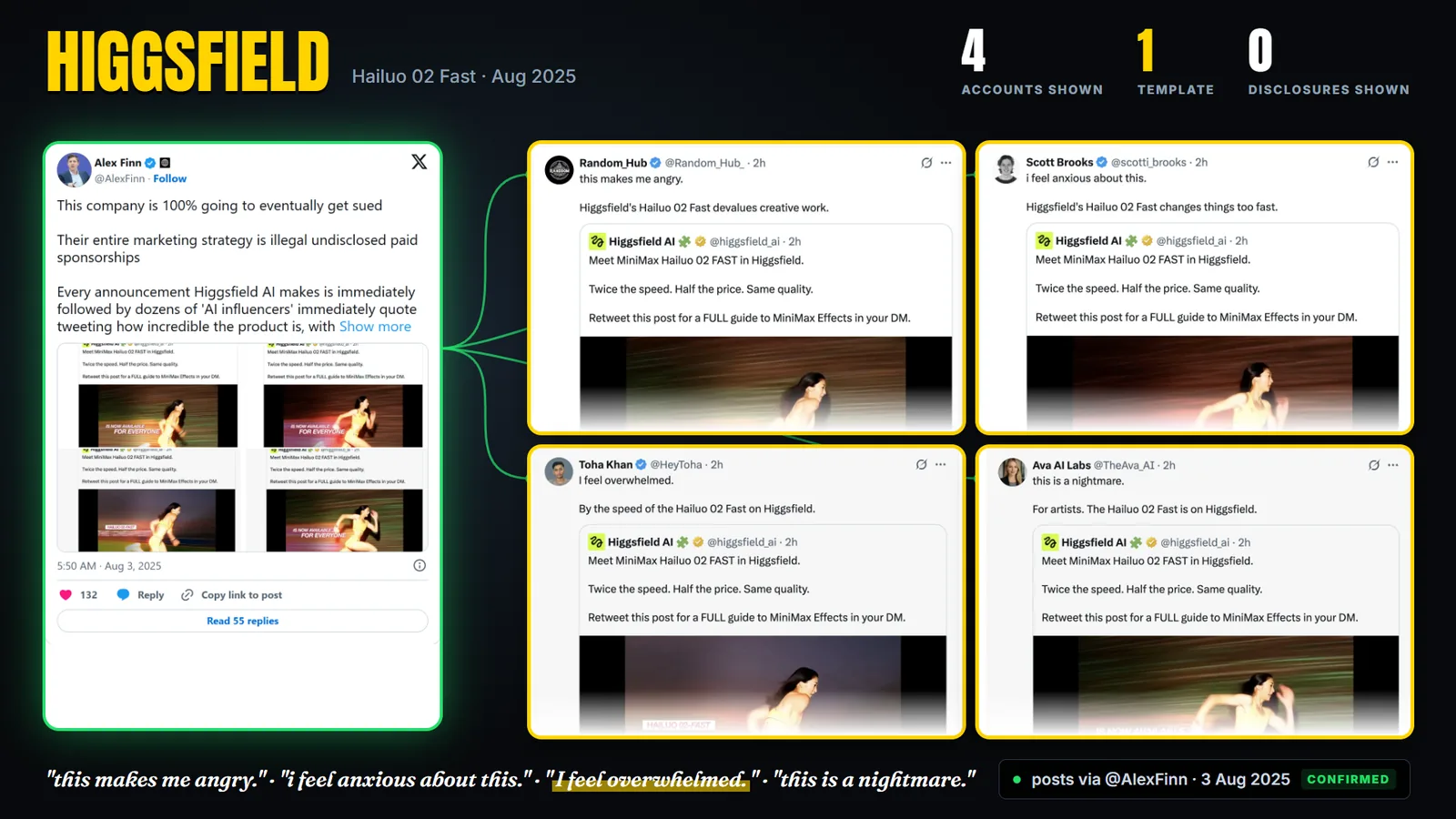
Higgsfield's Seedance launch post: about 15 million views and 1,543 likes. That's one like per 9,600 views. Real posts don't look like that. That's what it looks like when the view count is mostly bought reach.
So there are two different things hiding in these numbers. Paid promotion inflates the views. Creator waves manufacture the consensus. And I think people's agreeableness online does the rest. People want to be seen and heard, so real people jump on the bandwagon because they want to be seen liking and agreeing with the manufactured stuff.
The receipts
We actually have some receipts for all this.
Earlier this year Higgsfield offered a game director named Tim Soret $200 to share a post. He was a savage about it and called it out publicly. X suspended Higgsfield's account for "inauthentic behavior." Their CEO responded with "We recognize this and will do better."
I wonder if he meant they'd get better at this type of marketing.
Then in April, Nikita Bier from X publicly told Perplexity's CEO to "stop the undisclosed promotion campaigns." In public. On X.
Perplexity is on Doomers' client list too. To be clear, there is no evidence that Doomers ran that campaign. But the two biggest disclosure scandals in AI this year are both on the same client list.
The hidden tag
And here's the hidden trail I promised.
Doomers runs a public leaderboard of 1,867 AI launches, so you can see how your launch stacks up against OpenAI and everyone else. Nice marketing. Very data-driven.
In the code behind that page there's a little tag that marks which launches are theirs.
"dm": trueSixty-four posts. Twenty companies. Including two companies they never name as clients anywhere else.
So their own launches sit inside the leaderboard their clients get compared against, and the only way to tell which is which is to read the page source. Which I did. At two in the morning. Because I don't sleep anymore. I have a newborn.
(One more thing from that page. Only 7 of the 1,867 rows record how many followers the account had when it posted. Six of those seven are Doomers clients. Everybody else gets compared at today's follower count, after the launch made them famous. Draw your own conclusions about what that does to a "views per follower" ranking.)
Is it legal?
The coordination itself isn't illegal. It is against X's rules. X bans "coordinating with and/or compensating others" to inflate engagement.
Hiding the payment is where the law comes in. The FTC says if you got paid, you disclose. And that applies to the brand, the creator, and the agency in the middle.
Politics is worse, because there's basically no federal rule for paid creator posts. Both parties pay creators. Russia did it through Tenet Media. One study of over a hundred million tweets found that about 96% of sponsored posts were never disclosed.
So when people joke about "psyop as a service," it's not really a joke. There's a price attached.
My take
Look, I'm not going to pretend these guys are the devil. I'd probably use them myself. Or recommend them to friends launching products. Labelling most of your posts is better than crypto Twitter ever managed.
The problem is that there's this mass hypnosis going on, and everyone thinks it's one big party.
We can't trust "experts," because a lot of them are bought and paid for. And for a lot of these launches, the money doesn't go into the product. It's all a big hype train, we're in the attention economy, and there may be amazing software out there that never gets seen, because it didn't get the right amount of promotion while somebody with deep pockets threw money at one of these companies instead.
Shout-out again to Ben from Science Based AI. I loved that video.
And btw, X should really do something about reposts and replies not being shown as paid. They're the same thing. The algorithm needs to change if it wants to stay honest.
Elon was trying to make X by the people, for the people, right?
Anyway, that's it. If I spend any more time in front of this screen without checking on my wife and kid, I might not be allowed back.