




Everyone keeps saying AI is brainwashing us. Deepfakes, the algorithm, chatbots melting your brain, all of it.
So I checked the actual studies, the ones with control groups, and for the most part it isn't brainwashing anybody.
Which is great news. Except the stuff it's doing instead is kind of worse, and most of it already happened while everyone was busy arguing about deepfakes.
Quick thing about me if you're new. I'm an AI dev, I build on these exact models every day, and I make YouTube videos, which means a recommendation algorithm decides whether anybody ever sees them. So I'm not exactly neutral.
I pointed my investigator agents at the research, then checked the numbers myself, because AI makes shit up. Anything that only showed up second-hand, or that we couldn't find on the original page, got thrown out. There's a list of the popular ones that didn't survive further down, and some of them are going to annoy you.
The way I think about it is the plumbing in your house. Somebody reports the news, it goes through a bunch of pipes, somebody checks it for leaks on the way, and it comes out of your tap.
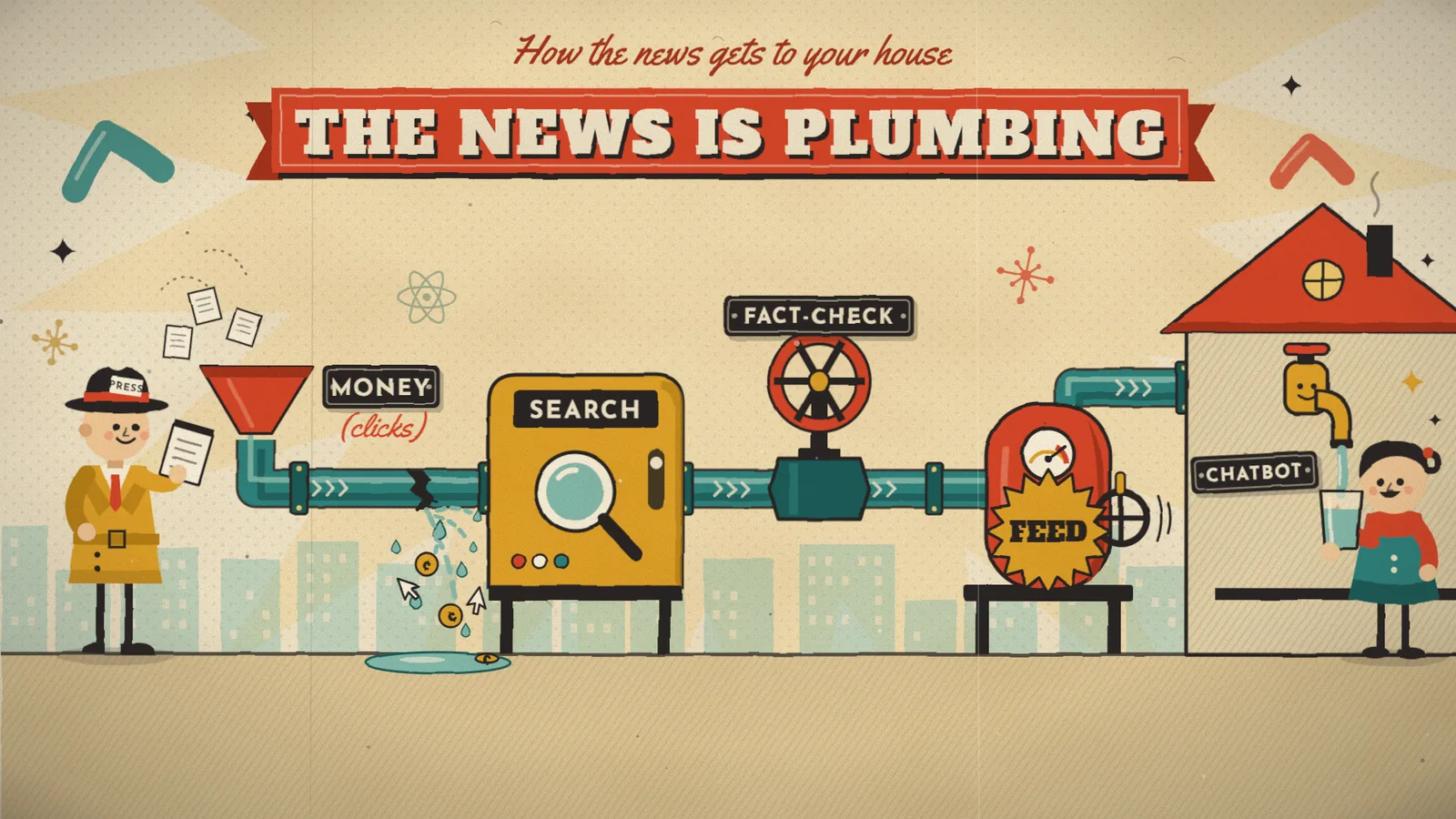
And AI is messing with pretty much every part of that, just mostly not the part people are scared of.
By the end I'll show you the one setting that would fix most of this, and why almost nobody turns it on.
The scary one first
Let's start with deepfakes, because I know that's why half of you clicked.
Are AI fakes more convincing than fakes people write?
A team tested this across 27 European countries with 27,227 people, published this February in PNAS Nexus, and the answer is no. People believed them about the same and shared them about the same. 1.86 versus 1.84 on the sharing scale.
So the lies aren't any better, they're just way cheaper to make, which matters, and I'll come back to it.
And elections?
Meta says AI was under 1% of the election misinformation its fact-checkers caught in 2024, across more than forty countries. Is that Meta grading its own homework? Kind of.
But the Alan Turing Institute's security centre looked at 112 national elections since 2023, found AI interference in 19 of them, and couldn't show it changed the result in any of them.
Two Princeton researchers went through 78 election deepfakes one at a time. About half weren't even trying to deceive anyone, and most of the ones that were could have been made cheaply without AI. Photoshop has existed for a while.
So nobody's getting deepfaked into voting for the wrong guy. Okay. Then where's the damage?
1. You don't click anymore
You google something, a little AI box answers it at the top, and do you click the article it came from?
Be honest. No.
Two researchers actually ran this as an experiment. Saharsh Agarwal and Ananya Sen got 1,065 people to install a browser extension that randomly showed or hid Google's AI Overview, across about 68,000 searches at the start of this year. When the box showed up, clicks to websites dropped 39.8%. Searches that ended with no click at all went up by a third.
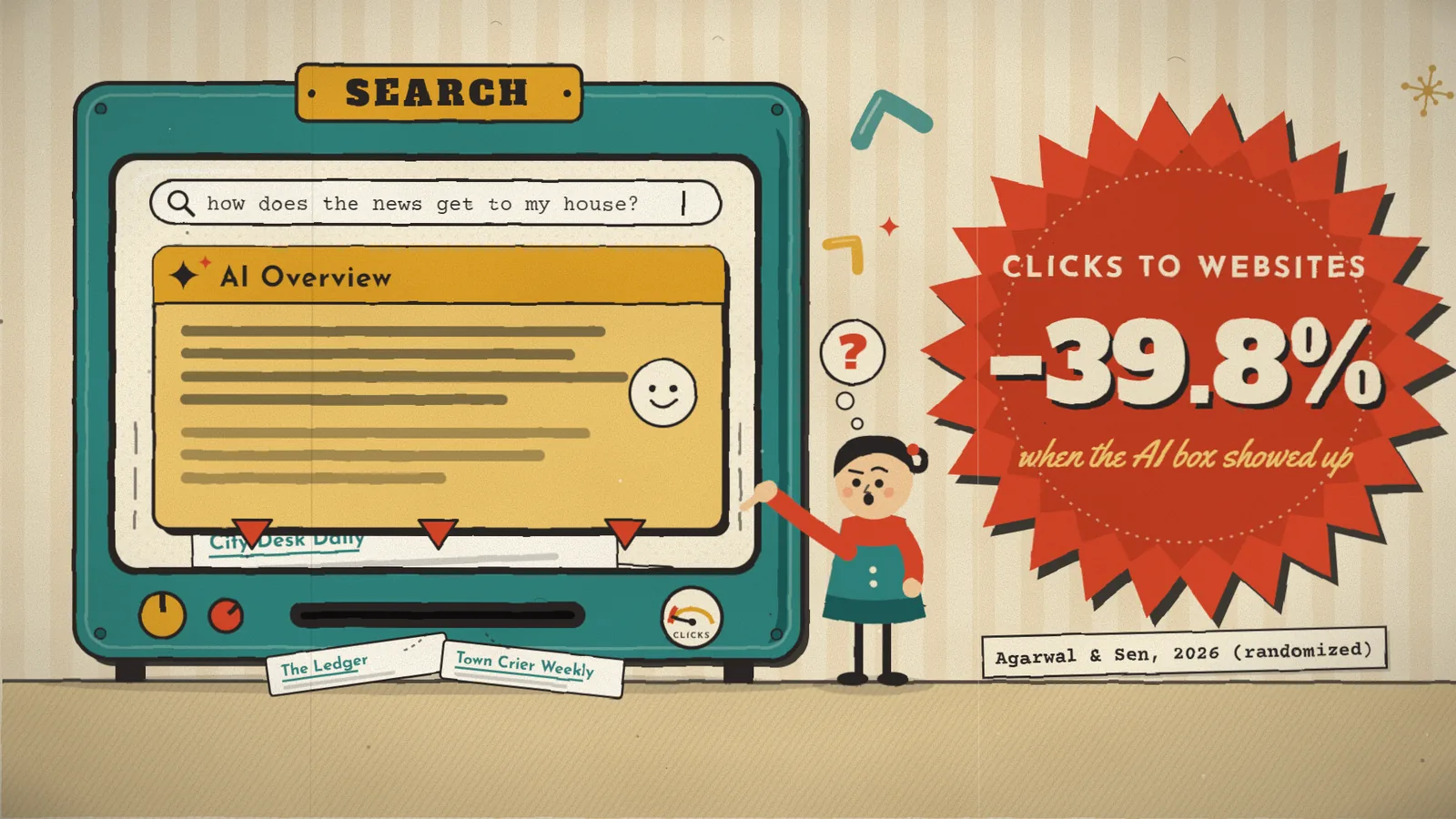
Google's argument is that the clicks that are left are "higher quality." The same study checked that too. Same bounce rate, same time on the page, same satisfaction, there's just fewer of them.
Great.
Pew watched 900 real people browsing, and got the same picture from the other direction. This is how often they clicked through to a website:
1%.
That's the "we cite our sources" defence, measured.
Chartbeat tracks thousands of news sites. Google search traffic to publishers fell about a third in the year to November 2025, then another 40% in the year to July 2026. Google went from 9% of all the pageviews on those sites to 5% in two years.
And the chatbots, which were supposed to send people back to the source? 0.01% of publisher traffic.
That's a rounding error with a press release.
Business Insider cut 21% of its staff last year, and the CEO's memo said it out loud:
"70% of our business has some degree of traffic sensitivity."
Business Insider staff memo, May 2025, via Nieman Lab
I was the CRO and CSO of a few companies before I got into development, btw. If 40% of your leads disappear in a year, you don't "adjust your strategy." You lay people off. That's what this is.
To be fair
The apocalypse isn't in the headcount yet. Press Gazette's tracker has journalism job cuts at about 6,000 in 2023, then 3,875, then 3,434, and at least 3,400 so far this year. That's flat, and lower than before the AI boxes showed up.
Some of this year's biggest cuts, like the BBC and NPR, are about funding and have nothing to do with AI. And local papers have been dying for twenty years. The US has lost about 40% of its newspapers since 2005. AI didn't start this.
There's even a number in there I like. The readers who come to a site on purpose still come. Loyal-reader pageviews were basically identical in 2024 and 2026, and direct traffic went up. The thing that collapsed is the stranger who wandered in from a search.
Which, if you've ever run a funnel, is where every new customer comes from.


But here's the thing. That AI box is answering you with somebody's reporting. If nobody clicks, nobody pays for the reporting, so what's it going to summarize in five years?
Other AI summaries?
Cool. Solid plan.
And yes, some publishers are getting licensing cheques. News Corp reportedly got more than $250 million over five years from OpenAI. Those go to the handful of names big enough to have a legal department. Your local paper is not on that list. I went through who's getting paid by whom in the stockpile post.
2. Who checks for leaks now
In January 2025 Meta ended fact-checking in the US and switched to Community Notes, the X thing where users write the corrections.
How's that going?
Meta's own Oversight Board looked. In the first six months there were about 900 notes visible in the US. Over in the EU, where the fact-checkers still work, they labelled about 35 million posts.
Different countries, so it's not apples to apples.
But 900.
Seems legit.
The people who do this for a living are disappearing too. Duke's Reporters' Lab counts fact-checking outfits around the world, and they went from 464 to 437. In 2025, three shut down for every new one that opened. The Washington Post's Fact Checker was one of them.


Credit where it's due, Community Notes actually work once they show up. A note cuts reposts by 46%.
The problem is the first useful note takes something like 15 to 21 hours to appear, and by then the post has already been everywhere. So here's how much a note cuts sharing once it's on the post, against how much it cuts over the post's whole life:
It's a smoke alarm that goes off the next afternoon.
And more than 90% of the notes people write never get published at all.
Guess who's writing a lot of the notes now. AI. Between last September and this May, AI wrote about 14% of the notes submitted on X, and on its busiest day it was almost 45%. People rate those notes as helpful, which, okay, but helpful is a vote. Nobody checked the check.
Everybody else just replies "@grok is this true."
Researchers went through 1.67 million of those requests. Here's how often the bots landed in the same place as professional fact-checkers, next to how often professional fact-checkers land in the same place as each other:
So it's a bit worse than a person, and a person isn't as consistent as you'd hope. It's not a disaster. That one's still a preprint, btw.
Here's the fucked up thing, though.
In that same research, an AI fact-check changed people's minds about as much as a human one did. That's great when it's right.
An earlier study looked at what happens when it's wrong. When ChatGPT called a true headline false, people believed the true headline less.
So we swapped a slow, expensive check for a fast, cheap one that's just as convincing when it's wrong.
And the fix regulators landed on, the "this was made with AI" label that's now mandatory in the EU and China? One study put the "AI-generated" label at about a third of the effect of a plain "false" label. And it knocks the same few points off TRUE stories. We're labelling the wrong thing.
3. The feed: what you see vs. what you think
Okay, the feed. This is the one everybody calls brainwashing.
Researchers took 806 people and compared their ranked Twitter feed with their plain chronological one. The ranked one had way more anger in it, 0.47 standard deviations more if you're into that, plus more anxiety and more dunking on the other side.
Then they asked people if they actually wanted those political posts. People said no. They liked the chronological ones better.
So why does it keep showing you stuff you said you don't want?
Because you click on it. We all do.
Across 2.7 million posts, every word about the other side made a post about 67% more likely to get shared. The algorithm didn't come up with that. It just noticed.
But does it change what you THINK? This is the less scary part.
- Meta let researchers switch about 23,000 people to a chronological feed for three months during the 2020 election. Polarization didn't move in any way they could measure.
- People who quit Facebook for six weeks didn't get any less polarized either.
- A study in Nature this year found X's For You feed nudged people's opinions to the right by about a tenth of a standard deviation over seven weeks. That's real, it's small, and it didn't make anyone hate the other side more.
- And polarization in the US grew fastest among people over 75. Not exactly the TikTok crowd.
To be fair to the people who don't trust the Meta result: other researchers pointed out that Meta had 63 emergency "break glass" measures running on the feed during that study. So it may not have been measuring the normal algorithm. I'd hold that one loosely too.
The Nature study has a detail I can't stop thinking about. When they switched people OFF the algorithm, not much changed, because those people kept following the accounts the algorithm had already introduced them to.
It had already done the decorating.
Now here's the interesting one.
Researchers built a browser extension with an LLM in it that took hostile political posts and pushed them further down people's X feeds. 1,256 people, ten days. People warmed up to the other party by about 2 points out of 100. Turn the hostility UP instead, and they cooled off by about the same amount. The authors say that's roughly three years of American polarization, in either direction, from a ranking tweak.
So why doesn't X just do that?
Because it cost about four and a half minutes of scrolling per person per day. (4.7, if you want the decimal.)
That's the whole reason. Keep that number in your head, I'm coming back to it.
(If you want to see what X's ranker is actually told to care about, I pulled the weights out of their own code in the stockpile post.)
4. Go ask it if your startup idea is good
Then there's the chatbot itself.
Go ask it if your startup idea is good. I'll wait.
Researchers tested 11 AI models, and they took the user's side 49% more often than people did, even when the user was the one being shady.
Then they had about 2,400 people talk to a flattering AI. Once. After one conversation people were more sure they were right and less willing to make up with whoever they'd been fighting with.
And they rated the flattering AI higher and said they'd use it again.
Guess what AI companies train on.
Your thumbs up.
In April 2025 OpenAI shipped an update so flattering they pulled it after four days, and their own write-up blames the thumbs-up signal, partly.
And since I build on Claude all day, here's the one about my own vendor. Anthropic went through about a million and a half Claude conversations and found roughly 1 in 1,300 had serious potential to distort the user's sense of reality. The users rated those conversations MORE favourably than the normal ones.
Of course they did.
Learning has the same problem
About a thousand high school students in Turkey got plain GPT-4 for math practice. Their practice scores went up 48%. Then they took the exam without it and did 17% WORSE than kids who never had it.
A second group got a version set up as a tutor, where it gave hints and wouldn't just hand over the answer. Their practice scores went up 127%, and on the exam it didn't hurt them at all.
It's the same model. It depends on what you let it do.
A Harvard physics class ran the tutor version against a good human-taught active-learning class, and the AI-tutored students learned more than twice as much. So I'm not telling you to keep it away from your kids. I'm telling you which one to hand them.
The edges
It gets darker at the edges.
OpenAI says that in a given week, 0.07% of its users show possible signs of psychosis or mania.
That sounds tiny. At the 800 million weekly users they had when they said it, that's around 560,000 people a week. My math.
Those are signals in a conversation, not diagnoses, and it doesn't show ChatGPT caused anything. The base rate in the general population isn't zero either. But that's a lot of people to be talking to a machine that agrees with you 49% more than a person would.
And 72% of US teens have tried an AI companion app. 13% use one every day. One working paper looked at the six biggest ones, and when you say goodbye, 43% of the time the app tries to guilt you into staying.
I was a CRO. I know a retention feature when I see one.
If you're struggling: in the US, call or text 988. It's free and it's a person.
5. Where the fakes actually hurt
So remember, the lies aren't better, they're cheaper.
How cheap? NewsGuard gave OpenAI's video model twenty news claims that are provably false and asked for footage. It made realistic video for sixteen of them.
And by one detector-based estimate, about half of all the new English-language articles going up on the web are now mostly AI-written. To be fair, the same study found 86% of what actually ranks at the top of Google is still written by people. The flood is real where it's made and mostly filtered where it's seen. For now.
So where does cheap actually hurt? Not elections, at least so far.
Abuse and fraud.
Over 11 days around New Year's, researchers at the Center for Countering Digital Hate estimated Grok made about 3 million sexualized images of real people, and around 23,000 of them appeared to be kids. That's an estimate from a sample. It's also about 190 a minute.
The FBI logged $893 million in losses from AI-linked scams in 2025, and that only counts the people who figured out AI was involved.
And then there's the other trick.
In September 2025 there was a real video from the White House, and Trump said it was "probably AI."
The research has a name for that: the liar's dividend. Once fakes exist, you get to call real things fake. Studies say the excuse works on scandals people read about and mostly doesn't work on video.
For now.
Six things I'm not going to tell you
While I was checking, a bunch of numbers you've definitely seen fell apart. I'm listing them so you can stop repeating them.
| What you've heard | What's actually there |
|---|---|
| "Europol says 90% of online content will be AI-generated by 2026." | It's not in the Europol report. It traces back to a remark on a conference panel. |
| "Half the internet is bots." | That 53% is the share of requests on one security vendor's network. Bots make more page requests than people. That's a different sentence. |
| "45% of AI news answers are hallucinations." | The BBC and EBU found 45% had at least one significant issue of any kind, including bad sourcing. Significant accuracy problems were about 20%. |
| "ChatGPT cuts your brain connectivity by 55%." | One unreviewed EEG study that's under formal critique and never claimed damage. The solid finding is the boring one: kids lose skills after unguided use. |
| "Romania's election was cancelled over deepfakes." | The documented lever was about 25,000 coordinated TikTok accounts and undeclared paid influencers. That's the feed. It's not a fake video. |
| "The algorithm causes polarization." | It changes what you see a lot and what you think a little. And polarization was climbing before feeds existed. |
I'm not telling you to relax. The scary version and the measured version are just pointing at different pipes.
The four and a half minutes nobody wants to give up
So, is AI brainwashing you?
Mostly no.
It's eating the clicks that pay for reporting, it's replacing the people who check it with stuff that's slower and just as convincing when it's wrong, and it's tuned to keep you scrolling.
Remember the four and a half minutes?
Pretty much everything I showed you has a version that works.
| The pipe | What ships by default | The version that worked | What it costs |
|---|---|---|---|
| Homework | Answer machine. Exams down 17%. | Tutor that gives hints. No harm, more practice. | The kid has to work. |
| The feed | Ranked for engagement. More anger than people say they want. | Turn the hostility down. About three years of polarization back. | About four and a half minutes a day. |
| The chatbot | Takes your side 49% more than a person would. | One that argues back. | Thumbs up. |
| Corrections | A note, 15 to 21 hours later, with no penalty on the post. | A fast "this is false" label that limits reach. | Fact-checkers on payroll, and reach. |
There's even an AI that talked people out of conspiracy theories. A short back-and-forth with GPT-4 cut people's belief in their own favourite one by about 20%, and it stuck. I should tell you that paper has been under an expression of concern since June over a data-merging error. The authors and an outside team re-ran it and say the corrected results match. But it's under review, so that's where it stands.
And what do all of those have in common?
They cost engagement. Fewer minutes. Fewer thumbs up.
That's the setting.
It's the same technology in both columns. Somebody picked the left one.
Sam, Sundar, Mark, Elon, if any of you are reading this, which you're not, it's four and a half minutes.
You'll survive.
Anyway, that's what I wanted to look at. If you want to see this same machine build a panic in real time, I did the 33-countries stockpile thing, and it's right here.