

For the last five days my timeline has been announcing the death of encryption, and almost nobody is linking to a primary document.
Anthropic broke RSA, or OpenAI did. Factoring is in P. ECDSA is toast, Ring-LWE isn't quantum-safe anymore, the Bank of England is worried, The Guardian and the Financial Times are writing about decryption nightmares, and twenty-one cryptographers just stood up a dark-mode committee page to manage the fallout.
So I pulled the papers, the GitHub commit logs, the Lean 4 repositories, the X post IDs, the Kalshi order books, the DNS records, and the live TLS certificates on the websites at the middle of the rumour.
No deployed encryption has been broken. Neither Anthropic nor OpenAI has published or claimed a polynomial-time factoring algorithm, and production RSA-2048, ECDSA (secp256k1 and P-256), full-round AES, and NIST's post-quantum standards (ML-KEM, ML-DSA) all hold.
The panic mashed together seven months of separate work: patched C bugs in OpenSSL and wolfSSL, a July paper on an undeployed lattice candidate (HAWK) and 7-round AES, a September GPU run on an 896-bit challenge key that sits 35.1 billion times below RSA-2048, an October Claude run that exonerated NIST's P-256 curve seeds, November's Lean 4 lower-bound proofs, one crossed-out blog comment at 03:48 UTC on November 25, and an independent advisory group born out of an MIT lattice workshop whose own website runs on a fresh RSA-2048 certificate.

In the stockpile post a few weeks ago, I joked that maybe these models would crack a Millennium Prize problem and win somebody a pile of money, right before saying you still can't trust the feed to summarise four press releases without starting a panic.
On November 20 an Anthropic researcher and Claude proved the Riemann Hypothesis in Lean 4, which is one of the seven Millennium Prize problems. Within a week the feed couldn't tell the difference between that, a circuit hardness bound, a 1997 Unix timestamp, and your bank login.
1. What the labs published
July 28: Claude Mythos Preview, HAWK, and 7-round AES
On July 28, Anthropic's Frontier Red Team published a cryptanalysis report (with companion code in anthropics/cryptography-research-demo) built with an unreleased model called Claude Mythos Preview. They ran multi-agent Claude Code loops at roughly $100,000 in API credits per target and came back with two real mathematical attacks.
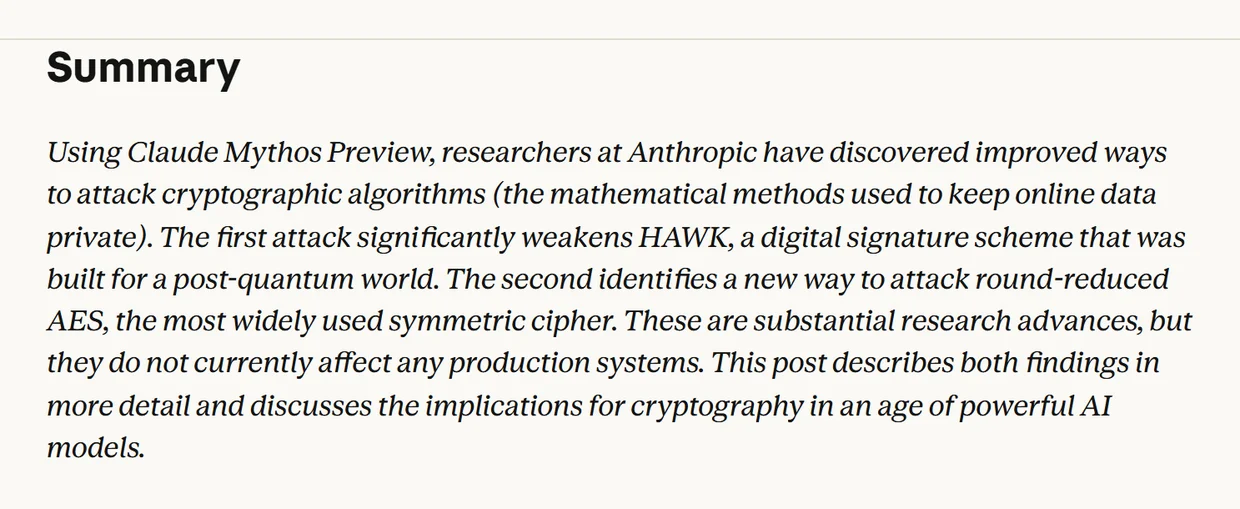
The first target was HAWK, a lattice signature candidate in NIST's post-quantum process (ePrint 2026/1593, by Zygimantas Straznickas and Stephen A. Weis). After about sixty hours of agent runs, Claude found an unused Galois involution in HAWK's noiseless Gram matrix that cut key recovery down to a Shortest Vector Problem in half the dimension (n/2 + 1). That dropped the challenge parameter set HAWK-256 from roughly 264 operations to 238, which Weis and Straznickas broke end to end in 3 hours and 42 minutes on one 96-core Xeon server. HAWK-512 fell from 2150 to 2108 gates, and HAWK-1024 fell from 2288 to 2182. HAWK's designers withdrew the scheme the next day.
People on X have been citing HAWK as proof that lattice cryptography and Ring-LWE are broken. They aren't. HAWK was built on the Module Lattice Isomorphism Problem, which publishes an exact, noiseless matrix. NIST's standardised post-quantum algorithms, ML-KEM (FIPS 203) and ML-DSA (FIPS 204), are built on Module-LWE, where deliberate additive error wipes out exact lattice symmetries. Falcon (FN-DSA) scales by a prime modulus (q = 12289) that removes the self-duality HAWK exposed; Weis and Straznickas write directly in the paper that their construction does not transfer to Falcon.
The second July target was 7-round AES-128, written up by Milad Nasr and Nicholas Carlini. Over three days and roughly a billion output tokens (steered by three short human prompts, typos left in, followed by nearly a month of human verification and Lean 4 formalization), Claude built an S-box parity-orbit technique they called the Möbius Bridge. It eliminated one of nine guessed subkey bytes and cut online time from 299 (the EUROCRYPT 2013 record) to 289.3, a 363x to 843x speedup depending on how you count cycles.
Look at what that 7-round attack still requires: 2105 chosen plaintexts and 292 bytes of RAM, which is roughly five billion exabytes, more memory than every hard drive and RAM stick on the planet combined. AES's wide-trail diffusion kills the shortcut at round 8, while real AES-128 runs 10 rounds and AES-256 runs 14. Johns Hopkins cryptographer Matthew Green reviewed both results on July 29: HAWK was a clean hit on an experimental candidate, and the AES paper was a theoretical constant-factor shave on a reduced-round toy nobody deploys.
(Footnote 1 of that July post also points to Anthropic's Project Glasswing bug tracker at red.anthropic.com/2026/cvd, which has logged 5,087 implementation bugs across 680 open-source repos and 230 CVEs this year, including 13 CVEs in wolfSSL and 10 in OpenSSL. One of the wolfSSL bugs, CVE-2026-5194, forged ECDSA certificates because a C parser mismatch left a digest length at zero; OpenSSL published another advisory, CVE-2026-121482, on November 24 right as the RSA rumours started. Those are C bugs. You fix them by updating the library.)
September 9 and September 19: RSA-260, RSA-896, and the GNFS cliff
In September, two AI labs broke historical factoring records within ten days of each other, and neither one touched the underlying maths.
On September 9, Cognition engineer Eric Lu used Devin (cognition.com/blog/factoring-rsa-260) to port open-source CADO-NFS onto spare Blackwell GPUs and factor RSA-260 (862 bits) in 15.57 days, burning 13.5 GPU-years. Ten days later, on September 19, Anthropic security engineer Stephen Weis (who did his MIT PhD under Ron Rivest, the R in RSA) used Claude to port CADO-NFS and orchestrate up to 2,048 idle H100 GPUs across 256 preemptible nodes, factoring RSA-896 (270 digits) in 10.07 days for 30 H100 GPU-years.
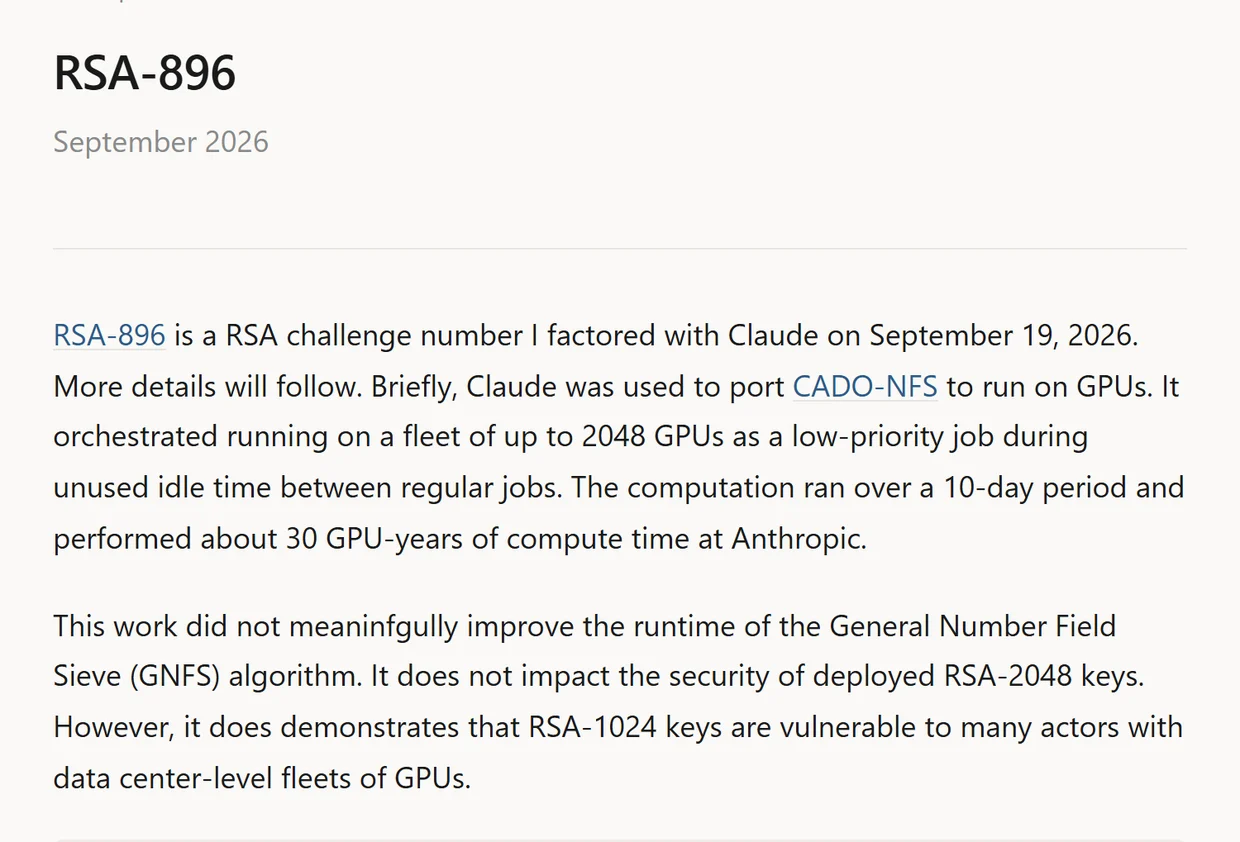
Both runs used the General Number Field Sieve from the early 1990s. Under GNFS's sub-exponential cost formula, LN[1/3, (64/9)1/3], adding bits multiplies the work on a curve that turns vertical fast. Calibrate that formula to Weis's 30 H100 GPU-years on RSA-896 (which predicts 11.5 GPU-years for RSA-260, right on top of Cognition's 11.7 post-polyselect GPU-years) and look at the jump:
| Key / Challenge | Size | Work vs. RSA-896 | Compute at Weis's H100 rate |
|---|---|---|---|
RSA-250 (Boudot et al., Feb 2020) | 829 bits | 0.15x | ~2,700 Xeon core-years (~4.5 H100 GPU-years) |
RSA-260 (Cognition + Devin, Sept 9, 2026) | 862 bits | 0.38x | 13.5 GPU-years measured (15.6 days) |
RSA-896 (Weis + Claude, Sept 19, 2026) | 896 bits | 1x | 30 H100 GPU-years measured (10.1 days) |
RSA-1024 (deprecated by NIST in 2013) | 1,024 bits | 30x | ~900 H100 GPU-years (~5.5 months on 2,000 H100s) |
RSA-2048 (deployed TLS / SSH standard) | 2,048 bits | 35.1 billion x | ~1.05 trillion H100 GPU-years (~105,000 years on 10M H100s) |
A 1,024-bit RSA key is now inside data-center range, which is why NIST told everyone to retire RSA-1024 thirteen years ago. A 2,048-bit RSA key sits thirty-five billion RSA-896 runs away.
(On the morning of November 25, at 10:21:27 UTC, Google Research also pushed a factoring paper into cogentic_research_papers at commit 4a7bc8ab, which briefly spooked commenters until people read the exponent: LN[1/3, 105]. It derandomized an older theoretical bound at a constant of 105 instead of GNFS's 1.923, making it astronomically slower than regular factoring.)
October 16: the NIST P-256 curve seeds (an exoneration read backwards)
If you saw posts claiming "Claude cracked NIST's ECDSA seeds" and wondered about Bitcoin or TLS, this is my favourite telephone failure of the whole month.
First, Bitcoin and Ethereum don't use NIST's P-256 curve; they use a Koblitz curve called secp256k1. Second, what Claude did to P-256 on October 16 (anthropic.com/research/ecdsa-curve-origins, claiming Filippo Valsorda's $36,864 ISRG bounty) was prove the NSA hadn't rigged it.
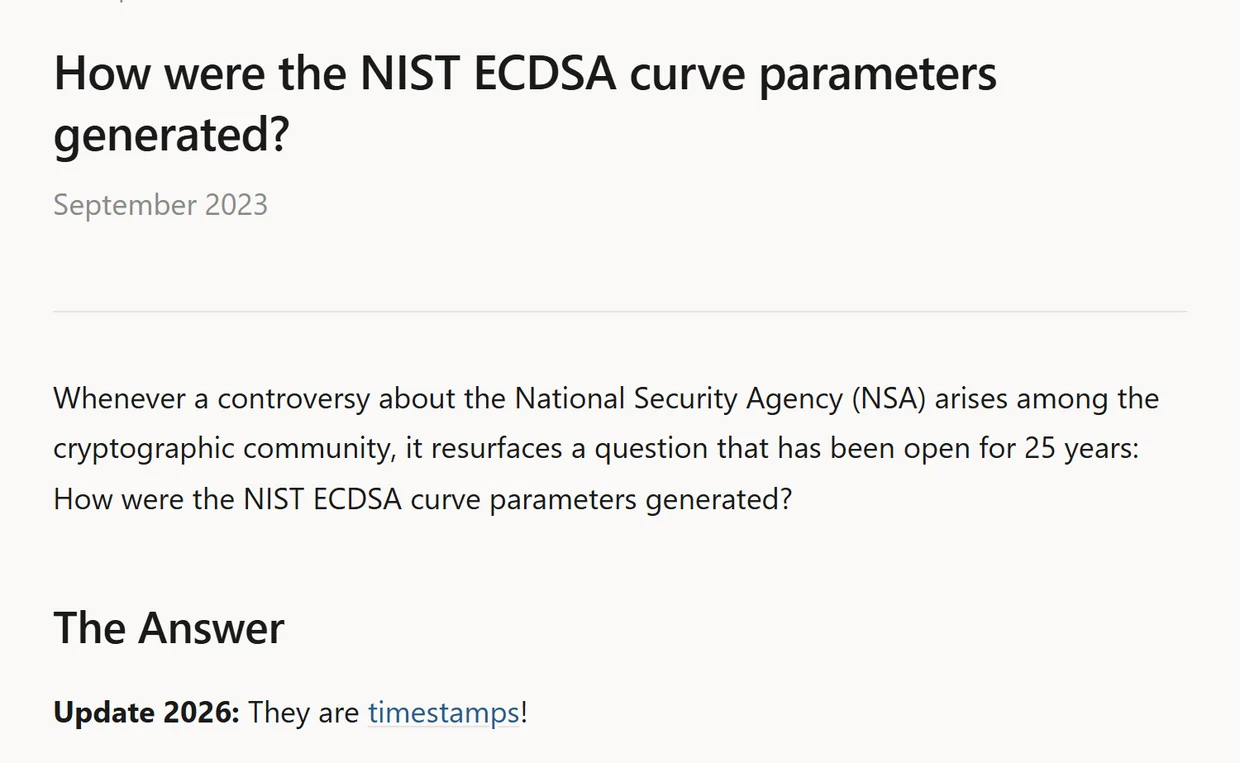
For twenty-seven years nobody could explain the 160-bit hex seeds inside NIST's 1999 elliptic curves. Late NSA mathematician Jerry Solinas had told D.J. Bernstein in 2014 emails that he hashed an English joke phrase like "Give Bob and Jerry a raise". Critics worried the NSA had secretly ground through 270 seeds to pick a secret weak curve.
Anthropic handed the raw hex bytes to Claude without Solinas's hint. In under thirty minutes, using LLL lattice reduction, Claude found there was no English phrase and no SHA-1 pre-hash at all. Every prime curve seed was raw consecutive output from 1990s POSIX srand48(unix_timestamp). Specifically, P-256's seed (C49D3608...) is block #1842 from srand48(871696354), meaning somebody at the NSA ran a C script at 01:52:34 UTC on August 16, 1997.
Proving the seeds came straight off a 1997 wall clock caps the NSA's wiggle room below 30 bits, which mathematically rules out the 270 seed-grinding backdoor theory. Claude cleared P-256's name, and X turned the words "Claude", "NSA", and "ECDSA" into a rumour that elliptic curves had fallen.
October 26 to November 25: the Lean 4 flood (and the constants nobody read)
Between late October and November 25, Anthropic (anthropics/formal-math) and OpenAI (openai/math, now sitting at 200,961 files and 730 manuscripts) began dropping formal Lean 4 repositories straight onto GitHub without press releases.
Every single one of the viral cryptography panics misread either the direction of the theorem or the constant hiding inside the big-O notation:
| Release (UTC) | What it proved | What the feed missed |
|---|---|---|
eth/ & SubexponentialSATOct 26, 20:35 (OpenAI) Oct 27, 03:07 (Anthropic) | Deterministic #k-SAT in 2O(n log log n / √log n) steps (1,052 Lean files, 152,420 lines in Anthropic's repo). | Still super-polynomial and slower than GNFS. Anthropic's 49-page paper notes it beats plain 2n brute force only past n > 1010,000 variables. |
| Riemann Hypothesis & GRH Nov 20, 12:52 (Alpöge) Nov 21, 13:55 (Lean FRO) | 175,187 Lean files (17,374,215 lines, zero comments; later compressed to 76,166 code lines by Luke Sernau), checked across nanoda, con-leche, and con-ron. | Cryptographers have assumed GRH since the 1970s. Proving it makes Miller's primality test and cyclotomic Ring-LWE reductions unconditional; it helps generate RSA primes, never factor them. |
vp-vnp/ & VPVNP.leanNov 23, 20:04 (Anthropic) Nov 24, 01:14 (OpenAI) | Separates Valiant's algebraic classes VP ≠ VNP (324 Lean files, 72,932 lines at Anthropic; OpenAI's history.md logs Nov 6 internally). | It's a circuit lower bound, the 1979 warmup to P ≠ NP, proving circuits need more gates. |
| Matrix ω = 9/4 & Fourier Nov 25, 00:04 (OpenAI 92b516ef) | Matching lower bound n9/4 on matrix multiplication, plus N(log N)1/2+o(1) linear gates for the DFT. | The new Fourier upper bound beats the 1965 Cooley-Tukey FFT only once N > 2600 (there are ~2266 atoms in the observable universe). |
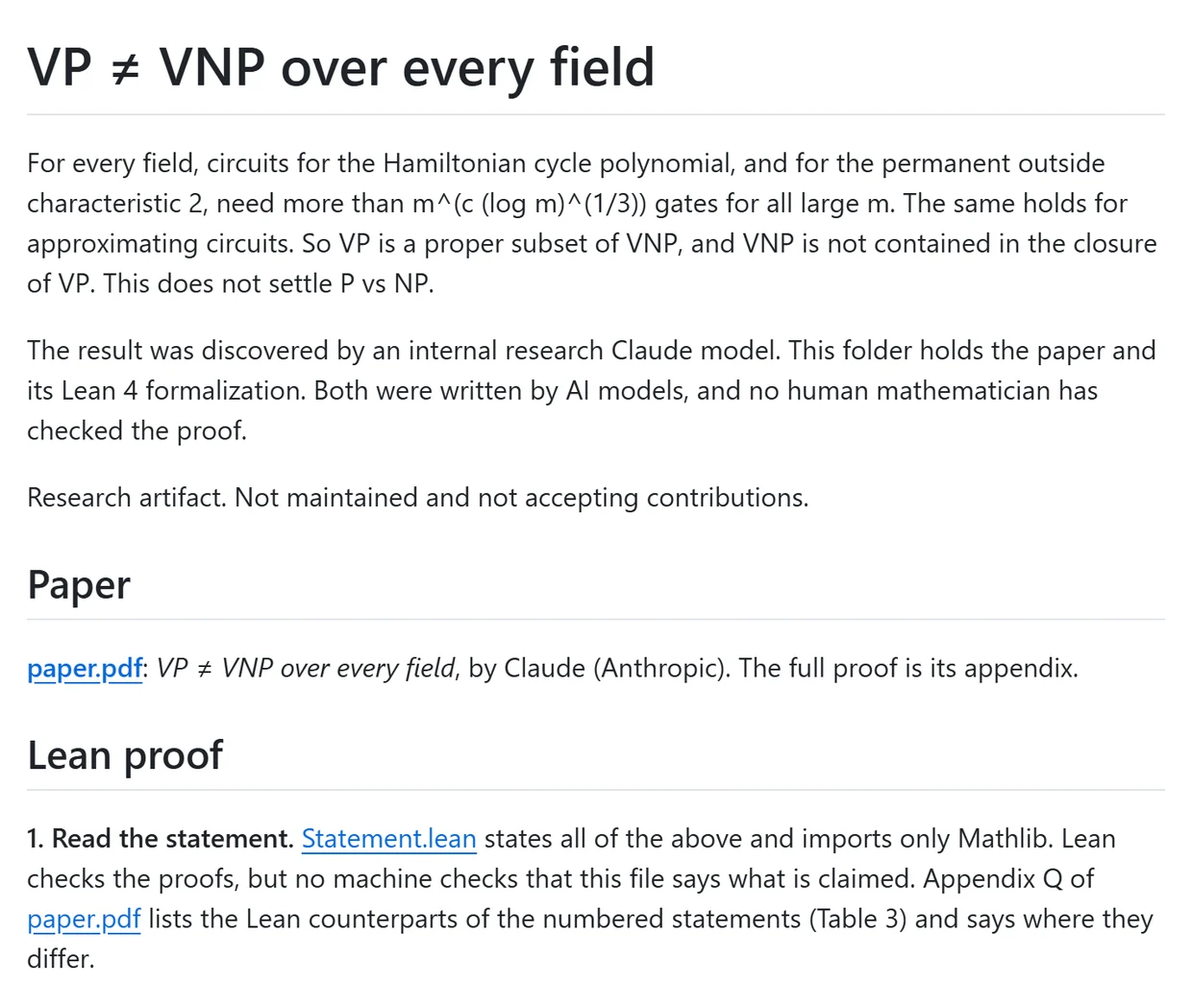
paper.pdf adds: "Whether the statements say what is meant was judged only by AI readers."Read Anthropic's README above. Even past the human verification gap (Appendix Q lists 66 numbered items in Table 3 and notes where the prose paper and Statement.lean diverge), VP ≠ VNP is a lower bound. Leslie Valiant posed it in 1979 as the algebraic warmup to P ≠ NP. It proves circuits need more gates, which is the mathematical direction encryption relies on. (And VNP is Valiant's NP, though replies all week kept asking about VPNs.)

2. The chain, decoded to the second
Just like in the stockpile post, X post IDs carry millisecond UTC timestamps inside their Snowflake bits ((id >> 22) + 1288834974657), and WordPress RSS feeds log exact UTC publication times. Put the whole five-day RSA panic back in chronological order and you can watch one caveat-heavy blog comment turn into central-bank questions and millions in betting volume.
| When (UTC) | Source / Post ID | What happened |
|---|---|---|
| Nov 24, 23:17:20 | scottaaronson.blog/?p=10362 | UT Austin complexity theorist Scott Aaronson publishes I've been drinking wine in my kitchen on the VP ≠ VNP releases. |
| Nov 25, 03:48 | Comment #23 (cid=2044495) | Replying to reader matt (03:43 UTC), Aaronson writes he has heard "many, many rumors" of Factoring in P, adds he doesn't know how much to credit it, and warns of "a game of Telephone." At 04:13 UTC (Comment #26) he puts his own P = NP odds at "2% and 2%." |
| Nov 25, 13:56:35 | @AndrewCurran_ (2125589468786909510) | First viral cropped screenshot of Comment #23 with the line: "This would crack RSA." |
| Nov 25, 16:52:48 | Ledger CTO @P3b7_ (2125633815519354949) | Charles Guillemet amplifies a bundled list of rumours across Factoring, ECC, and Ring-LWE. |
| Nov 25, 19:01:13 | scottaaronson.blog/?p=10379 | Aaronson posts HOLY SHIT... on ω = 9/4, repeats he is "much, much less confident" on specifics, and tells Bitcoin panickers to look elsewhere. |
| Nov 26, 02:35:59 | Kalshi KXFACTORP-35 | Kalshi opens short-dated "Factoring in P" contracts. By 10:01:43 UTC, the Jan 1 contract hits 65¢. Zcash drops 11.5% that day; Monero slides 22.0% over Nov 26 to 29. |
| Nov 26 to Nov 27 | BoE / BBC Radio 4 / @AndrewCurran_ | Bank of England Governor Andrew Bailey warns about AI and encryption (Nov 26); @AndrewCurran_ posts a four-rumour list at Nov 26 22:08:01 UTC (2126075530785276195); Marcus du Sautoy goes on BBC Radio 4 Today (Nov 27). |
| Nov 27, 20:01:14 | scottaaronson.blog/?p=10387 | Aaronson publishes Every call, stating the upcoming lab result "will not lead to imminent danger for any currently deployed cryptosystems." By Nov 28 00:44:55 UTC, Kalshi's Jan 1 contract crashes from 65¢ to 3¢. |
| Nov 28, 05:00:00 | The Guardian / FT | Four hours after the market prices the rumour dead, The Guardian runs Aisha Down's headline ("AI labs sitting on 'bombshell' revelations that could cause global chaos") and the FT runs "AI and the decryption nightmare." |
| Nov 29, 08:29:18 | Steve Weis @sweis (2126956656768799014) | Anthropic's RSA-896 engineer tweets cirg.org without context (4.11M views). Kalshi jumps back to 14¢. |
| Nov 29, 15:33:15 | zkpstandard/latticefrontier (fc671dd0) | 18 minutes after Oxford's @StefanoGogioso (15:15:00 UTC) connects CIRG's roster to an MIT lattice workshop, a workshop organiser edits "Understanding the Anthropic results" to "Discussion." |
| Nov 29, 16:25:38 | @sweis (2127076530337747130) & @elonmusk | Weis clarifies CIRG is independent of Anthropic. At 17:40:35 UTC (2127095392907248028), Elon Musk replies "I've heard this from a few people," restarting the loop. |
Here is Comment #23 on Aaronson's blog after he had to take a pen to his own comment section:
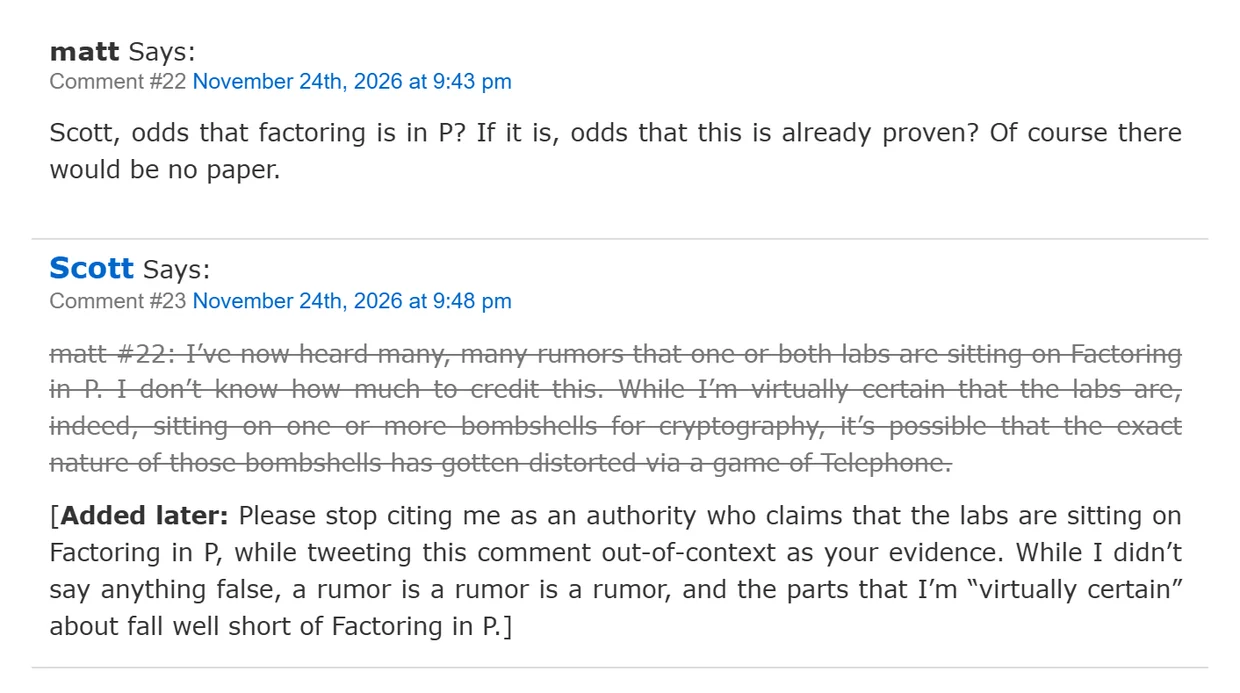
2026-11-25 03:48 UTC / 9:48 PM CST).And here is his Thanksgiving post (November 27, written as a phone call with "Rich Midwit calling from Snake-in-the-Grass Financial Newsletter"), plus Comment #87 on November 29 (19:18:43 UTC) where he also ruled out P = BQP:
"Look, I have specific information that the labs will soon release a major breakthrough in theoretical cryptanalysis—which breakthrough, however, will not lead to imminent danger for any currently deployed cryptosystems."
Scott Aaronson, "Every call," Shtetl-Optimized, November 27, 2026
Meanwhile Polymarket racked up $2.78 million in seven-day volume ($5.69 million cumulative) across its AI Millennium and P vs NP contracts, while Kalshi's short-dated "Factoring in P before Jan 1, 2027" contract (KXFACTORP-35-27JAN01) traced the exact arc of a rumour nobody checked:
Notice what didn't move on Polymarket: Bitcoin's actual SHA-256 and quantum-break contracts sat flat at 2% to 3% the entire week. The money chasing the screenshot was betting on vibes, while The Guardian and the FT hit print four hours after the market had already priced the rumour back down to three cents.
3. Forensics on cirg.org (and the 18-minute commit)
When Anthropic's Steve Weis tweeted cirg.org on Sunday morning, people saw twenty-one of the biggest names in cryptography (Dan Boneh, Matthew Green, Nadia Heninger, Chris Peikert, Eran Tromer, and MIT's Vinod Vaikuntanathan, Yael Tauman Kalai and Ryan Williams), saw "We advise on how to disclose a break" and "Forthcoming statement," and assumed Anthropic had assembled a crisis panel to announce the end of RSA.
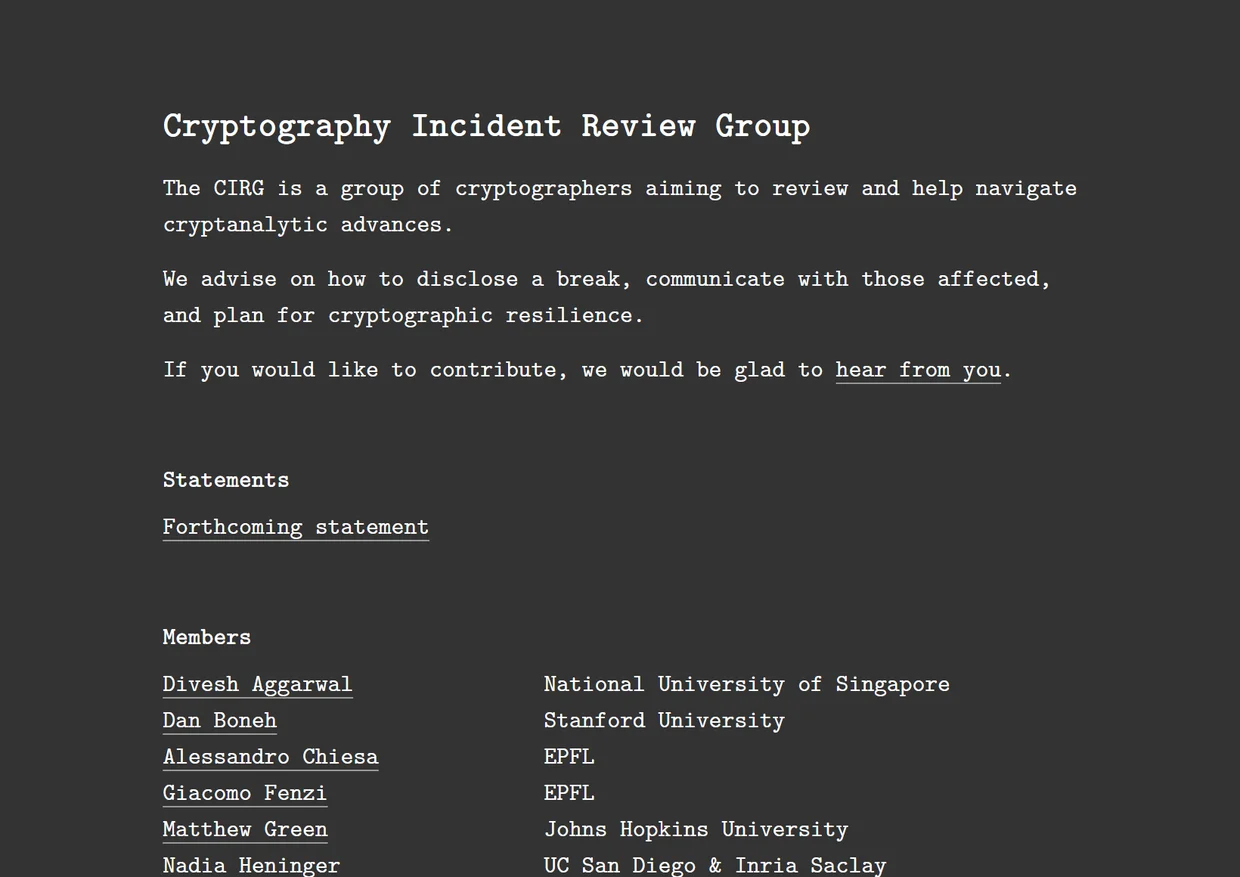
8,062 bytes, Last-Modified: Sat, 28 Nov 2026 18:02:32 GMT). Clicking "Forthcoming statement" serves cirg.org/statements/1/: "This statement has not been published yet."You don't have to guess where cirg.org came from, because DNS, RDAP, Certificate Transparency logs, and public GitHub history leave the whole trail in plain sight.
First, query the DNS CNAME on www.cirg.org. It points to cryptography-incident-advisory-group.github.io, hosted on GitHub Organization Cryptography-Incident-Advisory-Group (GitHub ID 358522046), which was created at 00:57:10 UTC on November 19, 2026, six days before Aaronson's blog comment. According to Public Interest Registry and GoDaddy RDAP records, the domain cirg.org (used until 2021 by an oncology group) was transferred and pointed at Cloudflare nameservers on November 23 between 07:08 and 14:08 UTC.
Why November 19? Because thirty-two hours earlier, on November 16 and 17, fourteen of CIRG's twenty-one members were at MIT CSAIL for the invitation-only Lattice Frontier Workshop, which ran a November 16 panel called Public Perception and Responsible (Non)Disclosure alongside NIST post-quantum specialists Ray Perlner and Yi-Kai Liu.
And in the public repository for that workshop, zkpstandard/latticefrontier, CIRG member Giacomo Fenzi had committed a November 17 noon panel titled "Understanding the Anthropic results" back on November 16 (3c054e8e). On Sunday, November 29, eighteen minutes after Oxford's @StefanoGogioso pointed out on X that CIRG's member list matched a lattice group rather than factoring specialists, commit fc671dd0 edited line 285 of the workshop schedule:
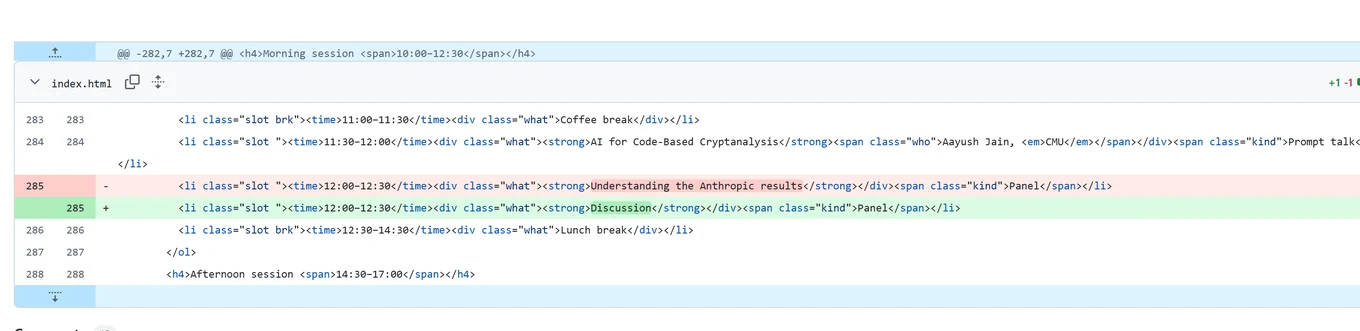
fc671dd0f4 on zkpstandard/latticefrontier, pushed 2026-11-29 15:33:15 UTC.Look at line 284 right above the red line: AI for Code-Based Cryptanalysis, at a workshop on lattice and post-quantum schemes, two months after Anthropic's Claude broke HAWK (ePrint 2026/1593) and shaved bits off Classic McEliece (ePrint 2026/1984). Academics who spend their lives evaluating post-quantum candidates met at MIT, talked about how messy disclosure gets when AI starts poking holes in candidate schemes, and stood up an independent review group over Thanksgiving.
Then open cirg.org and hit View Source. At the bottom of the 244-line file, right under the member list, is the contact section they hadn't finished setting up when Weis tweeted the URL:
<!-- Contact: fill in the address and uncomment.
<section aria-labelledby="contact">
  <h2 id="contact">Contact</h2>
  <p><a href="mailto:ADDRESS">ADDRESS</a></p>
</section>
-->
One more check, since this is supposed to be a panic about RSA-2048. Inspect the live TLS certificate that cirg.org itself serves when your browser connects to it (minted via Let's Encrypt YR1 at 2026-11-23 15:18:00 UTC, serial 0x6743c3ad8569eaf96023567d9b500677076):
| Live domain | Leaf certificate key | TLS 1.3 key exchange |
|---|---|---|
cirg.org (CIRG's own site) | RSA-2048 (rsa_pss_rsae_sha256) | X25519MLKEM768 |
saweis.net (Steve Weis's blog) | RSA-2048 (rsa_pss_rsae_sha256) | X25519MLKEM768 |
anthropic.com | ECDSA P-256 (secp256r1) | X25519MLKEM768 |
openai.com | ECDSA P-256 (secp256r1) | X25519MLKEM768 |
Twenty-one cryptographers do not launch an emergency website on a brand-new RSA-2048 certificate the week RSA-2048 gets broken, and Anthropic and OpenAI do not serve their own front doors on ECDSA P-256 and ML-KEM-768 if elliptic curves and Module-LWE have secretly collapsed.
4. Eight claims that fell apart
| What went around | What's on the page |
|---|---|
| "Anthropic or OpenAI broke RSA-2048." | Zero papers, zero claims, nothing factored past 896 bits. Under GNFS, RSA-2048 sits 35.1 billion times (~1.05 trillion H100 GPU-years) past RSA-896. |
| "Claude factored an RSA key with new maths." | Weis used Claude in September to port 1990s CADO-NFS onto up to 2,048 idle H100s (30 GPU-years), ten days after Cognition did RSA-260 with Devin. |
| "Anthropic broke post-quantum lattices / Ring-LWE." | July's HAWK attack exploited a noiseless Module-LIP matrix. NIST standards ML-KEM and ML-DSA use noisy Module-LWE, and Falcon uses modulus scaling; none of them are affected. |
| "Claude Mythos cracked AES-128." | It sped up a paper attack on 7-of-10-round AES-128 to 289.3 ops while needing 2105 chosen plaintexts and 292 bytes (~5 billion exabytes) of RAM. Full 10-round AES-128 is untouched. |
| "Claude cracked NIST's ECDSA seeds / Bitcoin keys." | Bitcoin uses secp256k1. On P-256, Claude proved in October that the 1997 NSA seeds came from srand48(871696354), ruling out a 25-year backdoor theory. |
| "Claude found unpatched 0-days breaking OpenSSL / BoringSSL." | Project Glasswing disclosed 10 CVEs in OpenSSL and 13 in wolfSSL (0 public CVEs in BoringSSL). All were ordinary implementation bugs in C, patched in updates. |
| "The Lean proofs (RH, ETH, VP ≠ VNP) break crypto." | GRH was already assumed and doesn't factor keys; the ETH refutation only beats 2n past n > 1010,000; VP ≠ VNP is a circuit hardness bound toward P ≠ NP. |
"cirg.org is Anthropic's crisis team for the break." | Independent panel of 21 researchers formed after MIT's Nov 16 and 17 Lattice Frontier Workshop. Unpublished first statement, mailto:ADDRESS commented out in the HTML, serving on an RSA-2048 cert. |
5. Why twenty-one cryptographers built the page anyway
CIRG member Vinod Vaikuntanathan at MIT put out one of the only direct comments from inside the group on Sunday afternoon (@Vinod_MIT, 14:00:01 UTC): "There's lately been a steady stream of speculation on social media about AI labs breaking cryptography. Some are blown up, others flat out wrong," followed by: "The future of cryptography cannot depend solely on the hope that our existing assumptions survive AI... Have Plan B and Plan C ready before Plan A breaks." Coinbase cryptography fellow Yehuda Lindell wrote a blog post the night before saying much the same thing.
Porting CADO-NFS onto 2,048 GPUs didn't change 1990s factoring maths, though it did compress months of ugly cluster engineering into ten days of spare capacity. At ~900 H100 GPU-years, any ancient router, VPN concentrator or internal CA still holding onto RSA-1024 is inside the budget of a well-funded lab. Retire it.
On the theory side, spending $100,000 and sixty hours of compute to cut HAWK's lattice dimension in half (and shaving heuristic security bits on Classic McEliece in ePrint 2026/1984) means candidate schemes get stress-tested much faster than human PhD students used to manage on chalkboards. If Aaronson's sources are right that another theoretical cryptanalysis paper is queued up from that November MIT workshop cycle, that's healthy pressure on new designs, even when deployed protocols stay safe.
What bothers me more is the verification bottleneck Matthew Green flagged back in July. Between Anthropic and OpenAI we now have more than 360,000 Lean 4 files sitting on GitHub where a tiny proof kernel says the deductions compile months before any human mathematician understands the argument inside, and where Appendix Q openly notes that only AI readers checked whether the formal statements match the English claims. In pure complexity theory, a subtle bug in Statement.lean means you proved the wrong theorem. In offensive cryptanalysis, nobody has to read 17 million lines of Lean to verify a key recovery: either the two primes multiply back to the modulus or they don't, and one line of Python settles it.
That's why twenty-one cryptographers stood up cirg.org over Thanksgiving weekend before they'd even uncommented the email address. If a real break ever lands against a deployed primitive, next year or ten years from now, finding out via cropped WordPress comments, Kalshi spikes, and quote-tweets is a catastrophic disclosure plan. We just watched how the internet handled a dry run where nothing was broken at all.
Your HTTPS is fine, your SSH keys are fine, and hybrid post-quantum key exchange (X25519MLKEM768, the exact cipher your browser already negotiates with anthropic.com, openai.com, and cirg.org) is already shipping in production. Kill any lingering 1,024-bit keys, update your TLS libraries when C patches ship, don't trade on screenshots of crossed-out blog comments, and check the page source once in a while.